Friday, October 23, 2020

The Heaps of Cornholme (Part 4 Henry Heap's family)

John Heap married Grace Brierley in 1840. They had 8 children between 1841 and 1862.

Their sixth child Henry was born in 1852 in Broadclough near Bacup. Some time in the mid 1850s Henry moved with his family to Cornholme. At about the same time James Ashworth and Mary also moved to Cornholme. Henry's family originally lived at Stubley Holme but then moved to Redwater Foot, opposite Frostholme Mill.

The 1871 census shows that Grace, now a widow, was living with her daughters Alice and Grace, and twin sons, George and Henry. Henry was shown as a Warehouseman in a Cotton Factory, probably Frostholme Mill.

Henry Heap


The 1881 census shows our Heap family living at 1 Birthright View. This address appears to have been renamed 1 Oakleigh Terrace before the next census in 1891. A photo of the house was shown in the last post (Part 3). But by now Henry was married and living with his wife Martha and daughter Alice Selina in Cliviger, the next parish to Stansfield.

Henry had married Martha Parsons in 1875. Martha was from Sabden near Whalley in Lancashire. Future posts will tell the story of Martha and her ancestors.

Henry and Martha's second daughter Ethel was born in 1882 but Martha died two years later. In 1891 Henry was living at 1 Oakleigh Terrace with his mother Grace, his daughters Alice Selina and Ethel, his twin brother George and sister Grace. In 1895 Henry married Martha Annie Holland. He is described as a Bookkeeper and then a Cashier in the next two censuses. Henry and Martha Annie had three children - Dorothy, George and Harry. He died in 1923.


Grace Heap died in 1894 and her sister Mary Ashworth in 1908. Douglas Wilson, a great great great grandson of Mary, has it on family authority that the widows Mary and Grace 'would sit by their firesides alternately smoking their clay pipes and no doubt chewing the cud'.

Ethel


Ethel is described as a Cotton Weaver in the 1901 census and was still living in Cornholme with her family. Two years later she married Harold Hiley (see Part 1).


Acknowledgement: 'Our Heap Family' by Rodney Heap

Wednesday, October 21, 2020

The Heaps of Cornholme (Part 3 Photos of Cornholme and the mills)

Photos of Cornholme and the Heap & Ashworth mills 
(taken in 2020)

Frostholme Mill on the right. In the distance, facing, is Oakleigh Terrace


Frostholme Mill


1 Oakleigh Terrace (end house)

Cornholme

Site of Caldervale Mill


Next post:  Henry Heap's family

Sunday, October 18, 2020

The Heaps of Cornholme (Part 2 Heap and Ashworth Cotton Manufacturers)

The Bacup Commercial Company was formed in 1850 and began business as weavers in a weaving shed in Wardle. In 1854 Farholme Mill was built at Stacksteads, Bacup and the business became the New Bacup and Wardle Cotton Spinning and Manufacturing Company. The directors were all local workmen and a contemporary report said the Farholme Mill was the best managed and wealthiest co-operative mill in Rossendale. John Heap was a a director, and James Ashworth, his brother-in-law, was the secretary of the company (See last post).

Soon afterwards John and James appear to have decided to go into business on their own account and built a weaving shed at Caldervale in Cornholme. At first there were three partners in the firm Messrs. Heap, Ashworth and Co., John and James being joined by John Fielding. The firm worked at Caldervale Mill through the depression of the cotton famine.

After 4 or 5 years at Caldervale, Heap & Ashworth built a weaving shed for 400 looms and a carding and spinning mill at Frostholme, near the Waggon & Horses, Redwaterfoot in Cornholme, just across the main road from Caldervale. They had a long run of prosperity. Later extensions included another shed for 300 looms.


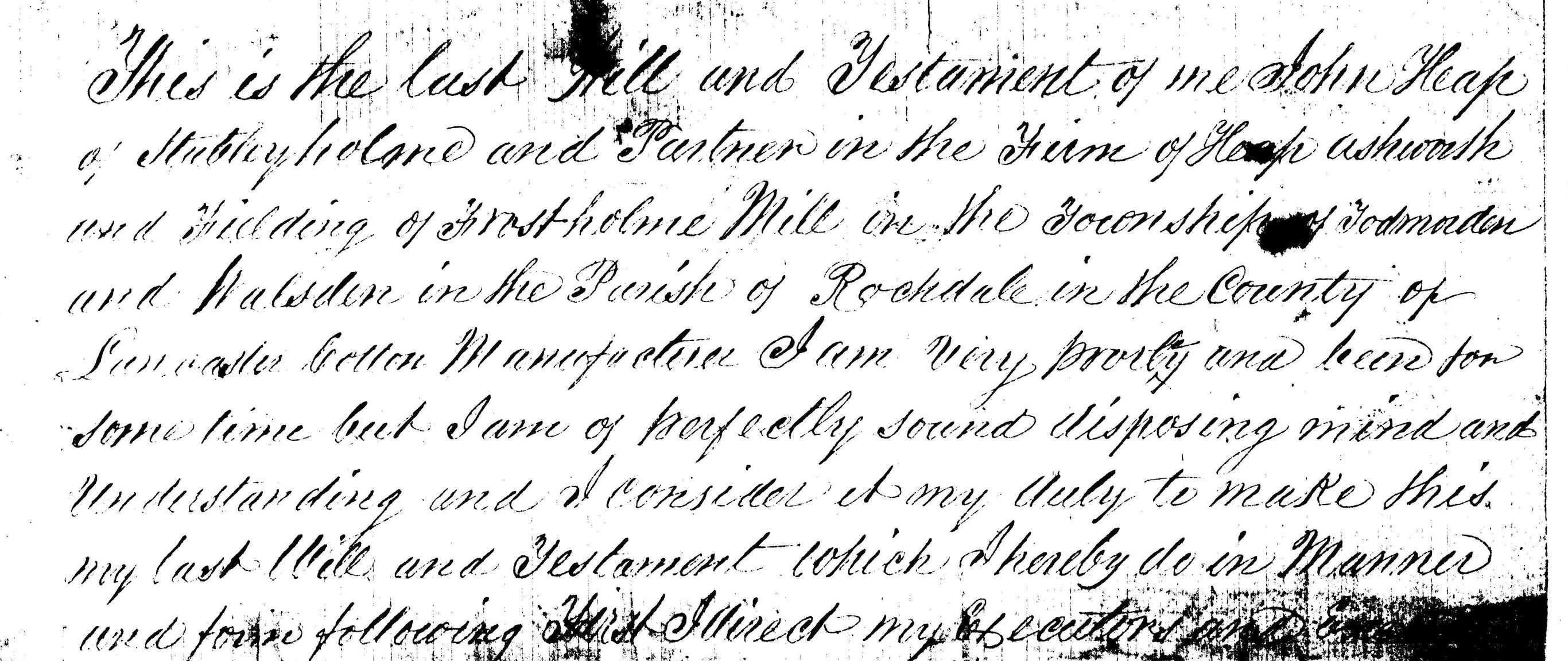
John Heap suffered from ill health for a number of years and died in 1863. In his will he asked that his share of the partnership be continued for the benefit of his widow Grace, and appointed his brother-in-law James as one of the executors.

The first few lines of John Heap's will, 1863

The accounts for 1869 are shown below. Profits of £1005 2s for the 2 years 1867 to 1869 might be equivalent to about £100,000 today.


James Ashworth carried on the business. In the 1871 census he is shown as a Cotton Manufacturer  employing 181 hands and in the 1881 census employing 267 men, women and children. Possibly owing to ill-health, he sold the business in 1882.

Sale of Frostholme Mill
Todmorden & District News 25th August 1882
Newspaper image © The British Library Board. All rights reserved. 
With thanks to The British Newspaper Archive (www.britishnewspaperarchive.co.uk)


Next post: Photos of Cornholme and the mills

Friday, October 9, 2020

The Heaps of Cornholme (Part 1 The Bacup Heaps)

Future posts will occasionally feature some of the families connected with the Hileys over the years. This month we look at the Heaps of Cornholme. Cornholme is a small village in Calderdale a few miles from Todmorden on the Burnley road.

The Heap surname came from Heap near Bury in Lancashire. In 1881 the surname was most common in Lancashire but with a substantial presence in the West Riding of Yorkshire.

On 6th June 1903 the Hiley and Heap families were joined when Ethel Heap from Cornholme married Harold Hiley from Walsden, a village a few miles away. 

Marriage of Harold Hiley and Ethel Heap
(with the permission of West Yorkshire Archive Service)
www.wyjs.org.uk/archives

Harold Hiley and Ethel Heap in 1903
possibly on their wedding day

Ethel's ancestors came from Broadclough near Bacup. The earliest direct ancestor so far traced is James Heap, son of James Heap, a weaver from Broadclough, and his wife Betty, who was born on 31st May 1801 and baptised on 6th July at the Bacup Wesleyan Church.

James Heap married Alice Law in 1821 in Newchurch Parish Church. James lived at Lanehead and Alice at Lordbarn, both small farms or properties a few hundred yards apart, about one mile north of Bacup. They had 9 children of whom the eldest was John, born in 1822. John married Grace, the daughter of James and Mary (nee Lord) Brierley in 1840.

James Heap came to an untimely end as this cutting from The Halifax Guardian describes.

Death of James Heap
The Halifax Guardian 13th June 1868
Newspaper image © The British Library Board. All rights reserved. 
With thanks to The British Newspaper Archive (www.britishnewspaperarchive.co.uk)


Green's Clough between Portsmouth nr Cornholme and Bacup

It seems likely that John and Grace Heap were close to Grace's sister, Mary Brierley and her husband James Ashworth, because John and James soon became business partners.

Next post: Heap and Ashworth Cotton Manufacturers

Monday, September 28, 2020

Alfred Hiley

Continuing the series of posts about notable Hileys...

This post features Alfred Hiley, a Clergyman, Mathematics teacher and writer of text books.

Alfred was born in Leeds in 1831. He took a degree in Maths at St John's College, Cambridge from 1857-60. He was ordained in 1860 and became Curate at Boston Spa, near Wetherby in Yorkshire.

In 1863 Alfred became Curate to his brother Richard William Hiley, the vicar at Wighill, and also took charge of the Mathematics department at Thorp Arch Grange school. This school had been founded in 1855 by Alfred's father, Richard Hiley, and was taken over by Richard William in 1861. From 1886 to 1910 Alfred was Vicar at the nearby church of St Peter's, Walton.

Alfred died in 1911 and was buried in the churchyard at Thorp Arch.  The inscription on his gravestone ends with the words: 'The kindest of brothers'.

Alfred Hiley

Alfred wrote a number of Mathematics text books, including:
Explanatory mensuration for the use of schools
Recapitulatory examples in Arithmetic
Key to Hiley's arithmetical companion, mensuration and book-keeping

Pages from two of his books are shown below.

From: Recapitulatory Examples in Arithmetic

From: Explanatory Mensuration for the use of schools


Alfred's brother Richard William wrote in his book 'Memories of Half a Century', published in 1899:

Perhaps ours is the only instance of two brothers co-operating in a private school, and vicars of two adjoining parishes.

Never did two brothers work on more harmoniously.........my brother proved the most unselfish and generous of men.....

Future posts will describe the lives of Alfred's father and brother.

Thursday, September 24, 2020

Littleborough Central School

Today's post features a photo from nearly 100 years ago.

This is a class of 42 pupils at Littleborough Central School in the mid 1920s.

Henry Hiley is 6th from the left on the back row and Barbara Kershaw is 4th from the left on the row in front. Henry and Barbara married in 1944.

Littleborough Central School 


In his later years Henry recorded a history of his life - 'HH remembers'. The following excerpt was entitled 'Starting at school, January 1924'. Nearly 80 years afterwards Henry recalled his first days at school:

Now it’s time I told you how I started at school. That would be when I was 5 years old in January 1924. I was well aware of what went on at that school because of course I’d had a brother and 3 sisters who had either been there or were still there, and the routine that was drilled into my mind was that the children would be larking round in the playground, chasing each other, playing their games, and making any amount of noise, when the schoolteacher on duty, whether a man or a woman – it could be Mr Beasant, it could be Mr Forrest, it could be Bob Butterworth, it could be Alice Holden, it could be Clara Rubberneck as we called her, Mrs Riley, Mrs Allerby, Miss Wilson - whoever was on duty would come out with a bell, like a town-crier’s bell. And, clang!, whatever was going on in the playground had to stop, and if any child failed to stop what he was doing in whatever attitude, he or she was sent in to receive the cane. At the second ring of the bell the children would line up in their classes and they would be marched in, in the morning to a full assembly where we sang a hymn and said a prayer, or after playtime directly to the classrooms, and in the afternoon of course directly to the classrooms.

Now then, on my very first day I was in the playground and decided that I needed to go across for a pee. The bell went. I was halfway across the yard. If I were to move I would be sent in to get the cane. If I didn’t go sharp I would wet my trousers. So what did I do? I had a pee there and then in the middle of the playground, and what the lady thought of me, if it was a lady, or a man, whatever the teacher thought of me, well that was it. In the first week or so I remember being sent home because I had dirty trousers but as far as I can remember there was no further such incident.

In the same class were, both boys and girls of course, all of us about 5 years old, no more, but in that same class was Barbara Kershaw. I remember one or two of the other girls as well – Alice Harrison, she was a cheeky thing, there was Matty Hacking, she was rough, and of course I remember a lot more of the boys. Especially on the street, we used to go out and play on the street, there was Geoffrey Collins who’s still alive, Edgar Chadwick, he’s dead now, Leslie and Albert Smith, Leslie's still alive, Albert was killed in a street accident only a few years ago. I’m speaking now in the year 2002. The Smiths’ father was a butcher. Geoffrey Collins’ father was a painter.

We played all sorts of games on the street, played Tig, chased each other. We rolled bullies, those were iron hoops. The girls used to have wooden hoops. We played Relivo - I can’t remember what that game was. Hopscotch, that’s fairly obvious. We even did some skipping but skipping of course was more a game for the girls. We used to play games under the street lamps in winter. I used to like to see the lamplighter come round with his long stick. He had a naked light at the end of it. The pilot lights were left on in the street lamps and it was up to the lamplighter to turn on the gas and light the…… it couldn’t have been the pilot light because he lit it with his long stick.

Friday, September 4, 2020

Heptonstall church

Heptonstall, recorded in the Domesday Book, is a township within the ancient parish of Halifax, set high on the Pennines above the Calder valley.

Heptonstall's original church, dedicated to St Thomas a Becket, was founded in about 1260, and was altered and added to over several centuries. The church was damaged by a gale in 1847 and is now only a shell, but a new church, St Thomas the Apostle, was built in the same churchyard.

Old and new churches 1909

Heptonstall church 2016

The first recorded Hiley baptism at Heptonstall was that of Mary, daughter of John Hylely of Erringden, on 26th July 1601.

Five Hiley marriages took place at Heptonstall, the first in 1605 between James Hileley and Susan Sutclyffe. The last, in 1761, was between James Highley and Martha Greenwood, 5 x great grandparents.

Marriage of James Highley and Martha Greenwood
(with the permission of West Yorkshire Archive Service)
www.wyjs.org.uk/archives

There were 19 Hiley burials at Heptonstall between 1611 and 1807 but there are now no remaining gravestones to be seen with inscriptions which record these burials.

The only gravestone with a Hiley connection so far established shows members of the Kershaw family, shown below. Henry Hiley married Barbara Kershaw in 1944 and the Kershaws on the gravestone are ancestors of Barbara. The photo was taken by Barbara's brother Derrick who researched his Kershaw ancestors in his retirement.

The Kershaw family grave at Heptonstall

Buried here are Martha Kershaw (nee Greenwood), Mary Farrer (nee Kershaw), Grace Kershaw (nee Farrer), John Kershaw, Abraham Kershaw, Martha Kershaw (nee Howarth), James Kershaw, Thomas Kershaw and Elizabeth Kershaw (nee Baldwin).

Derrick and Evelyn Kershaw cleaning the Kershaw gravestone

Charles J Hiley was the organist at Heptonstall for 43 years. See the post about him on 19th August 2020.