Showing posts with label Walsden. Show all posts

Friday, October 31, 2025

George Samuel Morris

Another story today from F.O.C.C.T., the Friends of Christ Church, Todmorden.

It describes the sad end of George Samuel Morris. Two of George's children married Hiley sisters - George Richard Morris married Alice Ann Hiley and Frank Morris married Betsy Hannah Hiley. Samuel, a brother of Alice Ann and Betsy Hannah, and my great grandfather, is mentioned in this story. 

George Richard and Alice Ann have already featured in a F.O.C.C.T. story in this Blog. Enter 'F.O.C.C.T.' in the 'Search This Blog' box to read their story and the others contributed by F.O.C.C.T.

38.10 – George Samuel Morris

George here was another transplant from Staffordshire who came here for work with his family. He met a wet end whose circumstances were sadly very predictable.
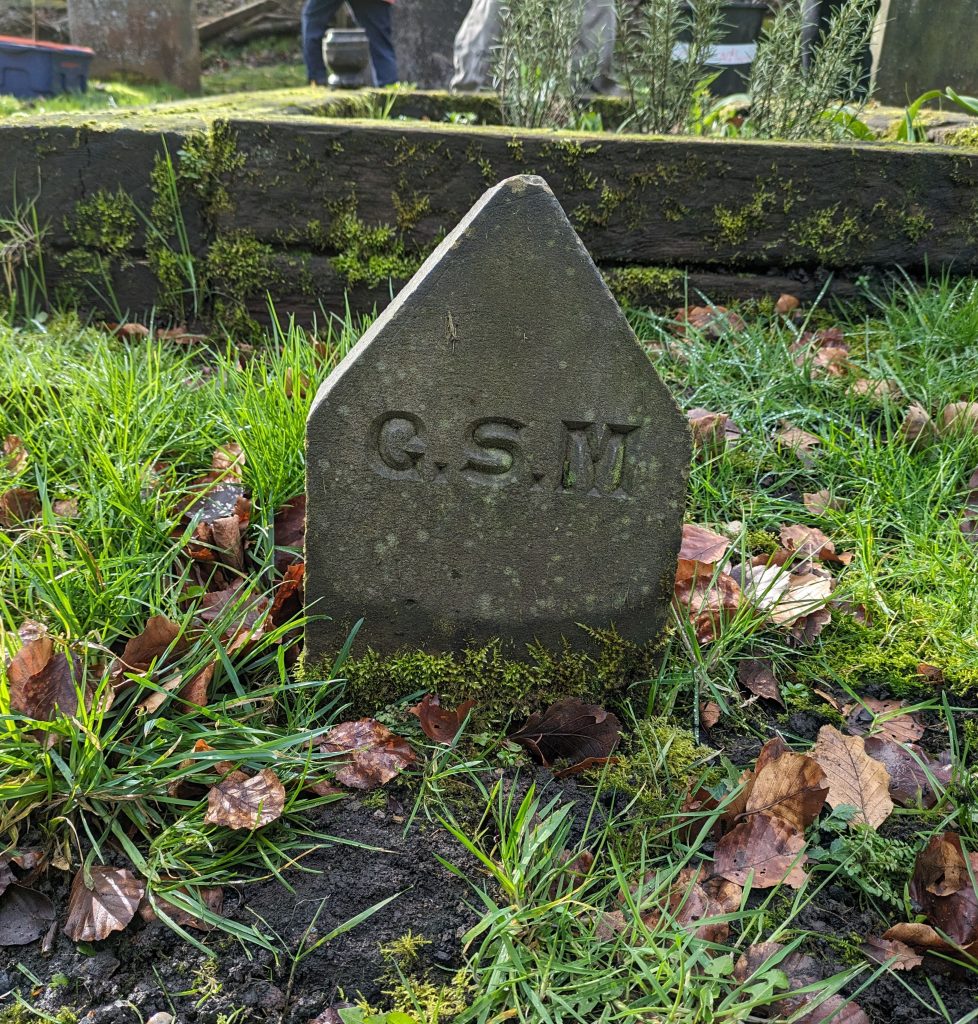
George Samuel Morris, or Samuel as he would choose to be known and to call himself, was born in 1820 in Monk Upton in Shropshire. His movements prior to his marriage to Mary Richards (whose surname we only know thanks to a family tree) are vague, and even his marriage isn’t firmly dated anywyere. But in 1858 he and Mary had moved to Tunstall in Staffordshire and they were welcoming their first child, their son George Richards Morris. 1859 saw the birth of Elizabeth Margaret and 1860 the birth of Simon. Shortly after Simon’s birth the Morrises came to Todmorden, and shortly after that Simon died. It was October 1861, he was a year old, and he was buried somewhere here at Christ Church.

There was then a six year gap before their third son and final child, Frank, was born in 1867. George and family had already settled near Gauxholme and in 1871 were resident at Lewis Street, Shade. George was working as a factory engine tenter, keeping the furnaces going. George seems to have liked a drink, getting picked up by the police now and again, but never for brawling or threatening behaviour…just a bit of staggering around.

On the night of July 22nd 1876, George left his house in the evening with a kiss to Mary and a promise of getting home soon so they could get to bed early. The Morrises by this point were living at Travis Holme, Clough, in Walsden. George headed down to the pub and never came home again. Mary and George Jr., Elizabeth and Frank waited for him, and waited, and waited. In the meantime Samuel Highley of Hollins Terrace was disturbed by a knock on his door at 11pm and answered it to find a very drunk George, who murmured that he was “a bad ‘un”, came in and sat, had a drink of water, sang a song, said again a few times that he was a bad ‘un, and then left. Samuel told him not to walk home along the canal, which was George’s preference, but George didn’t listen. Around 1am his children had had enough and went out looking, and Mary joined the search two hours later. It was Mary who found his hat and crutch on the canal bank. She got hold of George Jr., who went and got the police, and eventually on the morning of the 23rd the police arrived with grappling irons and pulled his body from the canal.
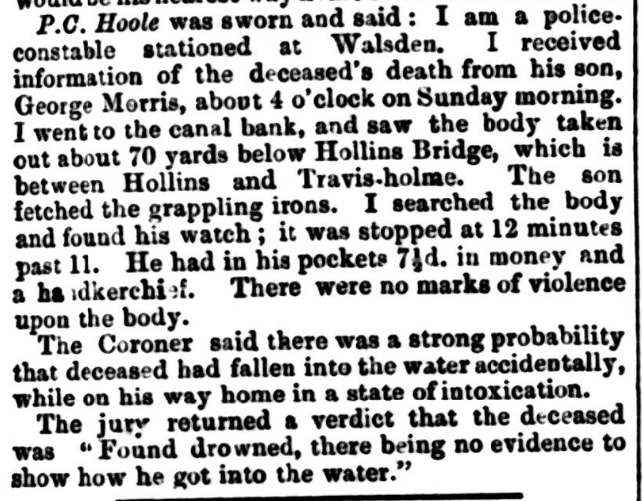
Todmorden Advertiser, July 28th 1876

The verdict was of drowning, with the reason unknown, as there was no real evidence to show he might have drowned himself intentionally apart from his statements to Samuel Highley. It was also his habit of walking home along the canal when drunk, known to everyone, and the jury clearly felt it was an accident. He was buried here, maybe with his son, maybe alone. The only initials we have here are his.

Mary died in 1882 and is also buried here at Christ Church somewhere. In the meantime, George Jr. married Samuel Highley’s sister Alice Ann. Something good came out of all that in the end…

Saturday, September 27, 2025

John and Mary Ann Bray Highley (Part 11 - John and Mary)

This is the final post in this series about John and Mary Highley and their family.

John died in 1929 at the age of 76. He had worked as a Cotton Weaver all his life. The last record we have of him is the 1921 Census where he is shown at age 68 working at Hollins Mill in Walsden for the Cotton Manufacturer Caleb Hoyle. 

Hollins Mill, Walsden in 2018

Mary carried on living at 106 Summit, Littleborough with Thomas Arthur and his family. The 1939 Register shows her occupation as ‘Retired. Unpaid Domestic Duties’. She died 2 years later at the age of 88. At the time, she was living with her daughter Mary Hannah in Todmorden. 

Entry in the Todmorden & District News 5th December 1941

John and Mary were buried at Calderbrook church in Littleborough.

Calderbrook church. View from John and Mary's grave

John and Mary's grave


Mary had lost 5 of her children in infancy and had lost 3 in the First World War. At the time of her death 4 of them were still living with their families. She had 20 grandchildren. She had survived her husband by 12 years.

Thursday, September 18, 2025

John and Mary Ann Bray Highley and their family (Part 9 - after the War)

In this post we look at the the fortunes of the families of John Henry, Ernest Jackson and Charles William after the War.

Grace
On 13 May 1921 Grace, John Henry's widow, together with Herbert (aged 12) and Jack (aged 7), left Liverpool for a new life aboard SS Melita bound for Quebec in Canada. 

SS Melita leaving Liverpool

This is Grace’s passenger declaration form for her arrival in Canada:
 

The family settled in London, Ontario. Grace married again in 1929.

Harriet Ann
Ernest Jackson and his wife Harriet Anne had had 4 children by the time Ernest Jackson was killed. Harriet Ann never remarried and lived to the grand old age of 92. She was the last of the various Highley families to live in the block of terrace houses originally known as Throstle Terrace in Walsden. She was living at 12 Throstle Street in 1932 - the 3rd house from the right hand end of the block.

Throstle Street in 2025


Mary 
This is a photograph of Charles William’s widow Mary and their daughter Miriam, taken in about 1930. Miriam had just turned one when her father was killed.


Miriam died in 1942 and is buried at Calderbrook church in Littleborough, although there is no gravestone there to remember her. Mary died in 1972 but there is no record of her burial.

Wednesday, August 20, 2025

John and Mary Ann Bray Highley and their family (Part 8 - Mary Hannah and Beatrice Annie)

Two girls in the family, Mary Hannah and Beatrice Annie, lived into adulthood. They both outlived all their brothers.

They each married local Walsden men, who were both called John and worked as Picker Makers at Stoneswood Picker Works.

Picker Makers at Stoneswood Picker Works
(Photo shown with permission of Pennine Horizons Digital Archive)

A picker was a strong leather attachment used in weaving looms to move the shuttle back and forth. These were essential items for the weaving process in the textile industry. Picker makers made them from Buffalo hide and the photo shows men at Stoneswood with their buffalo hides. Todmorden was one of the most important areas for its production in England.

Mary Hannah and her husband John Stansfield had 3 boys and a girl. They lived on Bacup Road near the Picker Works at Stoneswood. Beatrice Annie and her husband John Fielden Barnes had 3 boys. They lived on Sourhall Road off  Bacup Road.

Monday, August 18, 2025

John and Mary Ann Bray Highley and their family (Part 7 - Thomas Arthur)

Thomas Arthur was the oldest of the 12 children. He married Ann Selina Lobb in 1899 and the couple lived next door to his parents John and Mary in Throstle Street, Walsden before moving to Littleborough. The couple had 6 children before war broke out.

Thomas Arthur was a very late entry into the War. This entry appeared in the Rochdale Observer on 22nd June 1918.


Grade 2 was a common designation for men who passed the medical examination but were not deemed fully fit for front-line duties. We don’t know why Thomas Arthur enlisted at such a late stage of the War but he joined the RAF on 13th August 1918.

His enlistment document tells us quite a lot about Thomas Arthur, including some physical details which aren't available for his four brothers.


Thomas Arthur was attached to the RAF Reserve Depot which was a key unit for training and managing personnel. He worked in the Heaton Park Dispersal Unit in Manchester. This had the capacity for demobilising up to 3000 men per day.

He enlisted in August 1918, the war ended in November that year, he was transferred to the RAF reserve in February 1919, and finally discharged in April 1920.

Wednesday, July 30, 2025

John and Mary Ann Bray Highley and their family (Part 6 - Richard)

Richard was the youngest boy in the family. This is the record of his baptism in Inchfield Bottom Methodist Chapel in Walsden, like his older brothers and sisters.


The diagram below shows the service periods of the 5 brothers involved in the War. Although he was much younger Richard went to the Front before both Charles William and Ernest Jackson. The diagram shows the short length of time each of the other 4 brothers spent fighting. Richard’s service was about twice the total length of time served by all his brothers together.


Richard joined the same regiment, the Devonshires, as his brother Ernest Jackson, but he was in a different battalion, the 1sts. He is referred to in a number of newspaper reports, shown below.

The top one was part of the report shown in the last post about Charles William applying for an exemption. In fact the information about Richard having gone through the Dardanelles campaign is wrong because the 1st Devonshires weren’t involved in that part of the world.

The 2nd one is part of the report of Ernest Jackson’s death in July 1916, and shows Richard back in England at that time.

And finally a year later, in the report about Charles William’s death, we learn that Richard is still serving, and attempts were being made to release him from duties.


It appears that those attempts were not successful because Richard saw out the War. Although he had lost 3 brothers it was obviously felt that the British Army couldn’t manage without him. Richard’s medal card showed that he was entitled to the Victory medal, the British War medal and the 1915 Star. In the remarks it stated that he was placed in the Z reserve. After World War I, the Class Z Army Reserve was a temporary measure to hold discharged soldiers who were not yet eligible for full demobilization. They were required to return if called upon, but were otherwise free to return to civilian life. It was abolished the following year.

Sunday, July 27, 2025

John and Mary Ann Bray Highley and their family (Part 5 - Charles William)

Today's post tells the story of Charles William, the third of the brothers to lose his life in WW1.

Charles William Highley

When Charles William was born in 1889, Ernest Jackson was 10 and John Henry was 12. Before the War his life followed a similar pattern to his older brothers – working in the Cotton Mill as soon as he was old enough, then marrying a local girl and starting a family. The article in The Todmorden Advertiser above says that he was well-known in the district. He married Mary Carr on 20th March 1915 and their daughter Miriam was born in May the following year. Shortly after this Ernest Jackson was killed so Charles William had lost both his two older brothers who had gone to fight in the War.

In September 1916 Charles William applied for an exemption to being called up. A separation allowance was a payment to soldiers who were separated from their family due to serving in the war. He was given an exemption until 30th November that year. The other brother mentioned is Richard who survived the war and is the subject of the next post.


The following January Charles William enlisted in Todmorden with the 15th Battalion of the Lancashire Fusiliers, known as the 1st Salford Pals.

When Charles William joined the Battalion in France they were fighting in the Somme region, but at the beginning of June they travelled by train to the extreme northern end of the Western Front, on the Belgian coastline at Nieuport. In a book on the Salford Pals the author Michael Stedman said that ‘the area provided the best opportunity for personal cleanliness that anyone could remember. At rest, behind the lines, a brief stroll took the men to the seaside, fishing, bathing and taking the sun.’

But away from the seaside in the frontline trenches there was heavy fighting and Charles William was killed in action on 22nd June.

Charles William was initially buried in a French Military Cemetery but after the war a number of graves were brought in from the battlefield and nearby smaller cemeteries and he was reburied at Ramscappelle Road Cemetery.

The burial return shows that he was identified by a piece of his boot which was stamped with his service no. 27557.


Ramscappelle Road Cemetery, Nieuport

Charles William's gravestone

Charles William was the last of the 3 Highley brothers to die. No two of them served at the same time in France or Belgium and the total time spent abroad between the three of them was only about 11 months.

Monday, June 23, 2025

John and Mary Ann Bray Highley (Part 3 - John Henry)

John Henry was born in 1877, the second of John and Mary's children. By the age of 14 he was working as a Cotton Weaver in a mill in Walsden.

John Henry married Grace Speak in April 1900. A son Jesse was born later that year but died of measles at only 8 months old. They had 2 more sons, Herbert in 1909 and Jack in 1913.

It appears that John Henry and Grace had a stormy relationship, at least early on in their marriage. In December 1900, under a heading of ‘An Ill Matched Walsden Couple’, The Todmorden District News reported on a case where John Henry was summoned for assaulting his wife. Grace had gone to the Conservative Club where John Henry was playing billiards in order to fetch him home. She claimed that her husband had hit her outside the club and then again when they got home, all of which John Henry denied. He claimed that Grace had got her mother, brother and sisters to come and take all their wedding presents away to her mother’s house. The case was dismissed and the Mayor said that they must go home and live together again.

John Henry also appeared in the local paper in connection with cricket. He played for Knowlwood in the Calder Valley League, opening the bowling and batting at no. 3.

John Henry was already a reservist in Walsden with the 1st Battalion East Lancashire Regiment so when war was declared in 1914 he was ready to serve straightaway. The regiment was part of the 11th Brigade in the 4th Division. They sailed to France on 22nd August. His battalion was involved in the Battle of the Aisne and the Battle of the Marne and then moved north to Flanders in the sector on the French/Belgian border north-east of Armentières. The Battalion was heavily involved in the Battle of Armentieres at the end of October. This action was part of the fighting called ‘The Race to the Sea’ where the Allies fought to prevent the Germans breaking through to the Channel ports.

John Henry died at the 10th Field Ambulance at Le Romarin on 1st November 1914 of wounds received in action. He had been in France for only 2 months.


He was initially buried in a little cemetery at Fortrie Farm in Neuve-Eglise and then reburied after the war at the Trois Arbres Cemetery at Steenwerck.


John Henry's gravestone


Trosi Arbres Cemetery, Steenwerck


Saturday, May 31, 2025

John and Mary Ann Bray Highley (Part 2 - the children)

John and Mary Ann Bray Highley had 12 children:

Thomas Arthur 1875 - 1952
John Henry 1877 - 1914
Ernest Jackson 1879 - 1916
James Edward 1882 - 1887
Mary Hannah 1885 - 1964
Sarah Alice 1887 - 1890
Charles William 1889 - 1917
Fred 1892 - 1892
Martha 1892 - 1892
Richard 1893 - 1953
Beatrice Annie 1896 - 1974

The 1911 census showed that John and Mary had had 12 children born alive of whom 5 had died. James Edward died at age 5, Sarah Alice at age 3, and the twins Fred and Martha were born prematurely and died after a few hours. There is no record that tells us more about their 12th child.

Nine of the children were baptised in the Inchfield Bottom Methodist Chapel in Walsden. The Chapel closed to worshippers in 2010.

Inchfield Bottom Chapel, Walsden

Three of the boys were killed in the First World War - John Henry, Ernest Jackson and Charles William. The next few posts will look at their lives before the War, where they fought and where they are commemorated, and what happened to their families afterwards.

Two boys, Richard and Thomas Arthur, took part in the War and survived. They both married and had children. Mary Hannah and Beatrice Annie both lived into adulthood, married and brought up families.

At the time of his marriage to Mary Ann Bray in 1874 John was living at Throstle Terrace in Walsden. His parents Thomas and Sarah had moved there at some time before the 1871 census was taken. From that time until about 1932, a period of over 60 years, there were various members of this Highley family living at Throstle Terrace.

The photo below shows Throstle Terrace and the Lanebottom Wesleyan Methodist Chapel and Sunday School.


The houses on the roadside were 935 - 945 Rochdale Road. At the back was Throstle Street (numbered 8 to 18). The whole block was known as Throstle Terrace.

935 - 945 Rochdale Road

Throstle Street. No. 8 at the end


Sunday, May 25, 2025

John and Mary Ann Bray Highley and their family (Part 1 - John and Mary)

This is the first of a series of posts telling the story of a Walsden family of Highleys broken apart by the First World War.

John Highley was born in 1852 and was a direct descendant of David Hiley born in Warley in 1700. His parents were Thomas and Sarah (nee Jackson). The census of 1851 shows the family living on Todmorden Road, Bottoms, Walsden, with Thomas working as a Steam Loom Weaver (Cotton). 

John was one of 7 children. By 1861 the family had moved to Victoria Terrace in Todmorden and John, just aged 9, was already working as a Cotton Throstle Spinner. In 1871 they were back in Walsden, at 2 Throstle Terrace. John was a CottonWeaver.

Mary Ann Bray Wills was born in Cornwall in 1853 and was the oldest of 10 children. Her family, looking for work, made the epic journey to Todmorden at some point between 1871 and 1874. On 17th May 1871 this entry appeared in The Cornish Telegraph:


John married Mary Ann Bray on 4th April 1874 at Cross Lanes Chapel between Hebden Bridge and Heptonstall.

Marriage Certificate of John and Mary Ann Bray


Cross Lanes Chapel
From the Alice Longstaff Collection

Between 1875 and 1896 the couple had 12 children.


Next post - John and Mary's children

Tuesday, August 20, 2024

The life of Henry Hiley Part 6 - Henry's Grandparents' house in Walsden

In this post Henry talks about his grandparents' house in Walsden.

Sunny View, that's where the grandparents lived, they had an interesting house. Grandad had bought a property about 1923. The deeds - I'm sorry that we don't have a copy of the deeds – but they went back to the year of Trafalgar, 1805, and in 1805 there had been built into the hillside at Walsden this block of nine rooms, three by three. They just went back the depth of one room into the hillside. The shop had five of the rooms on the low road. There was the bakehouse built into the hillside. In the middle was the living room, very tiny, and then there was the shop. Above that two bedrooms belonging to that complex, over the bakehouse and the shop. They were still into the hillside – there was no way out at the back, quite solid, and then on the room over the shop, that was free-standing. That came out on to a steep back lane and that was the Grandparents' living room and above it they had the bedroom. Theirs was a two-room dwelling. That left two rooms still on the top floor and they were single room dwellings.

Henry's plan of the property:


The property in Walsden 
(155, 157 & 159 Hollins Road)

The first person I remember living in one of those was Aunt Clara, that was Father's Aunt Clara, and later Grandad went to live in that particular one and later again Mary took the other one, the third on the way up. She lived there for a short time after she’d come out of the convent at Burghwallis.

Mary's apartment
(One room dwelling no. 3 on Henry's map)

The property had been bought by Grandfather round about 1923/4. When he died it was left to his three children, that was Uncle Frank, Father and Aunt Annie. Eventually it came to belong to Father. It was let out. The shop was rented by Bert Hird. He was the uncle of Thora Hird, the actress. He had the five rooms. When Grandad died then of course no member of the family lived in any of the apartments but my father did eventually go back there and lived in the first, going up the hill, of the one-room dwellings. Mark you, my grandfather had moved up there before then, and he lived the rest of his life there after Grandmother died except for a day or two at the very very end when he went to Burnley and died at Aunt Annie's.

Sunny View on Top o' th' Hill Road
(The Grandparents' house)

My father would go there, into the property, after he gave up Glaisby Cottage and Barbara and I took over the tenancy of it. When Father was very ill he came to live with us in Windermere. Agnes took over the ownership of the whole property. She lived in the shop and worked the shop. She didn't do any baking. She just had John Kenneth with her and managed to make both ends meet by looking after the shop. All in good time she took in Mary. Mary lived in the top floor in the last of the one-room dwellings. I think that was it. Eventually Agnes sold the whole property and we, as a family, had no further financial interest in the complex.

I can't remember that any of those houses of Grandfather's had a water supply actually to the house. There would be a supply, a cold water tap, to Bert Hird for his baking and for the shop, but unusually at that time and in that part of Lancashire, or the West Riding of Yorkshire, (we were very close to the boundary between those two counties) in working class homes, Grandfather had a water lavatory. There was a little washhouse outside, very close of course, where there was a cold water tap and where Grandmother used to do her washing, and alongside it was a water lavatory and directly below it was a water lavatory for Bert Hird and his family, for the shopkeepers.

The property's flag roof seen from Top o' th' Hill Road
(Henry mentions this above)

Tuesday, August 6, 2024

The life of Henry Hiley Part 5 - Henry's Aunts and Uncles

Henry's father Harold had an older brother Frank and an older sister Annie. Another sister Agnes had died in infancy. Annie married Herbert Jackson and Frank married Martha Hannah Greenwood.

In this post Henry talks about visits as a young boy to his Aunt Annie and Uncle Frank.

Henry's mother Ethel died two months after Henry's 4th birthday.

Now of those four years I hadn't spent all four years at 72 Victoria Street, Littleborough. I take it that when mother was ill I was sent off for a few months, well I don't know for how long, to Burnley to my Aunt Annie and Uncle Herbert. Uncle Herbert was a parkkeeper at Ightenhill Park in Burnley. Annie was Father's older sister, Sarah had started nursing, Annie was still at school, at Burnley Grammar School, Willie - I don't know exactly what he was doing. I know I liked the house. I remember particularly there was a little pigsty quite close and I used to like to go and have a look at the pigs over the pigsty door and I used to love to see them crunching coke. I heard afterwards that for them to crunch coke, that was good for their stomach, almost like people with bad stomachs taking a charcoal pill nowadays.


This photo was taken on the occasion of Willis Jackson's wedding in Cheshire in 1938.
From L: (Uncle) Herbert Jackson, Samuel Hiley (Henry's grandfather), Sarah Jackson, Ron Atkinson (who married Annie, Sarah's sister, (Aunt) Annie Jackson (nee Hiley)


Willis Jackson, Henry's cousin,
receiving his DSc in Manchester


Whilst I was sent off to Burnley, Mary was sent to Uncle Frank and Aunt Martha Hannah. We all loved their house. It was called Bank Cottage. We always called it The Bonk and there was a big garden going down to the Rochdale Canal. Uncle Frank – I can't remember him growing vegetables, perhaps he might have grown a few peas, but he certainly grew flowers and people came from far away, well, from Walsden, to buy flowers from him. He kept hens as well. He had a greenhouse. He grew tomatoes in the greenhouse and always had one or two plants that produced yellow tomatoes. Those were a speciality. And the chickens – he used to hatch the eggs in his own incubator, then we children used to love to see the baby chicks pecking their way out of the shell looking pretty wet and sticky and bedraggled when they did get loose from the shell but quickly drying off under the lamp of the incubator and showing their fluffy, fluffy feathers.


Uncle Frank and Aunt Martha Hannah.
Grace Annie (Henry's stepmother) is in the back


Bankwood Cottage, Walsden


Sunday, June 30, 2024

The suicide of Betsy Eastwood

For today's post I am indebted again to F.O.C.C.T. The story below is reproduced from their website with permission.

F.O.C.C.T. – Friends of Christ Church, Todmorden (focct.org.uk) 

Reuben Hiley (1862-1934) was a grandson of Reuben and Betty Hiley. Reuben (snr), known as 'Old Wraggs' lived at Nicklety in Walsden. He was a Road Labourer and Quarry Man and has already featured a number of times in this Blog. 

In 1918 Reuben (jnr) was a Canal Lock Man for the Rochdale Canal Company. He lived with his wife Sarah Ellen (nee Webster) at the Lock House in Gauxholme, Todmorden. 

Reuben gave evidence at the inquest into the death of Betsy Eastwood.

15.12 – John Edward and Betsy Eastwood

Betsy Scholfield was the daughter of Samuel Scholfield (a fish hawker) and Sarah Ann Kershaw. She married John Edward Eastwood (a postman) at Walsden Parish church on 6th November 1902. On 25th July 1905, John Edward dies aged just 32 years old. Betsy moves back to live with her parents and brothers at 771 Rochdale Road. By 1918, it appears that it’s now just Betsy and her brother William living at the address. Her mother died in 1914 and at least one brother is currently fighting in the 1st World War.

On 15th January 1918, Betsy disappears.

(Todmorden & District News – Friday 15 February 1918)

MISSING THREE WEEKS.

INQUEST ON WALSDEN MYSTERY.

“Last Saturday afternoon, Deputy Coroner Norris held an inquiry at the Town Hall in reference to the death of Betsy Eastwood, of 771, Rochdale Road, Walsden, whose body had been found in the canal the previous Thursday.

Wm. Scholfield, brother of the deceased (with whom she resided), identified the body. Deceased, he said, was a widow, and was 43 years of age. She had not enjoyed good health for the past few years, and at the beginning of November she was attended by Dr. Stevenson for a nervous breakdown. The doctor told them she would want watching. She was hysterical at that time, but she seemed to improve somewhat, although she had occasional fits of depression.

The Coroner: Did she ever make any statement that would lead you to suppose she would do something? — Witness: She once said she thought she would never be right until she got into a wooden box, but when I have talked to her, she said we had no occasion to be frightened, that she would not do any harm to herself. She had fretted about her younger brother, who was in France, especially when letters did not arrive regularly. Witness went on to say that she disappeared on January 15th, and although inquiries were made amongst all the friends of the family, both in the district and at Littleborough and Rochdale, nothing could be ascertained as to her whereabouts. On Thursday, Reuben Hiley, of Gauxholme Lock House, told him they were going to draw off the water at Nip Square Pool, Walsden, so that they could repair the lock head. He went to see the water drawn off, and the body was found embedded in the mud in the middle of the bed of the canal. It was very bad to get at, and they had to get waders on, and get some pieces of wood, on to which they floated the body. On account of the position of her clothes he could not identify the body just then, but next morning he went down to the mortuary, and he had no doubt that the body was that of his sister, although her face was much swollen and dark coloured.

Reuben Hiley, Lock House, Gauxholme, spoke to drawing off the water at Nip Square, for the purpose of carrying out some repairs to the lock head. They found the body fast in the the mud in the bed of the canal, the head and the upper part being completely covered. The body had probably been in the water for some time, and would have remained there a long time if the water had not been drawn off.

Elizabeth Cryer, 1, Bar Street, said she prepared the body for burial. There were no marks on the body, but judging by appearances, it had probably been in the water a fortnight or three weeks.

The jury returned a verdict of suicide whilst of unsound mind.”


The Lock House at Gauxholme
Photo taken in 2018