Friday, April 8, 2022

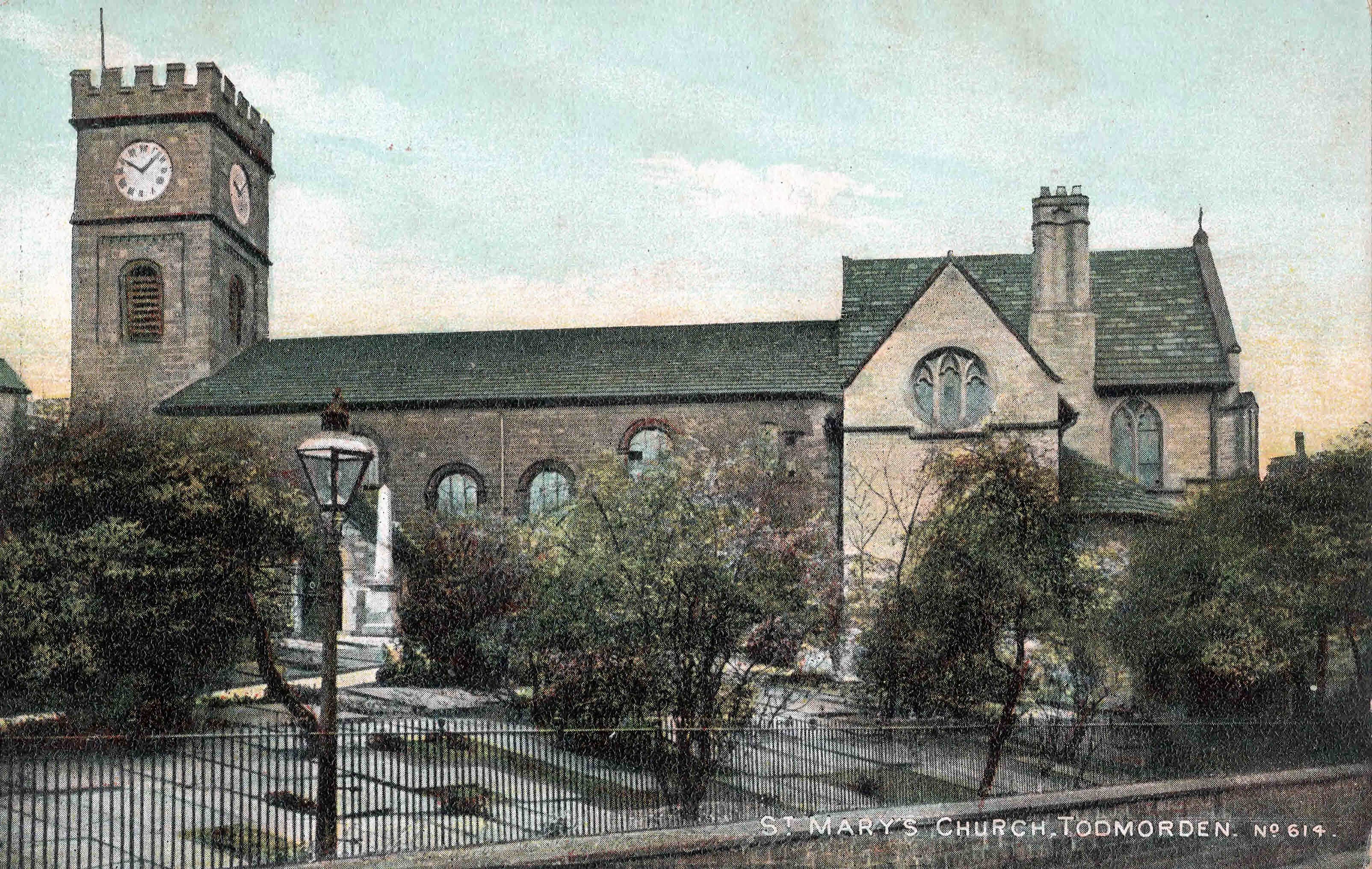
Todmorden St Mary's graveyard

The first Hiley/Highley burial at Todmorden St Mary's was that of Mally Highley, the daughter of John and Grace (nee Ogden). Mally's grandfather James and his brother Mark had been the first Highleys to take up residence in the Todmorden area some time in the 1750s after moving west away from Warley.

Mally was baptised at St Mary's on 5th February 1789 and was buried there on 29th February 1792. Mally's sister Sarah and brothers Thomas and Tommy all died in infancy and were also buried there. The family were living in Gauxholme, Walsden at the time of Mally's death.

Linda Briggs writes in her website 'Todmorden and Walsden': In 1930 a road widening scheme in Church Street meant that the present raised pavement was constructed over part of the graveyard, and in 1968 the gravestones were removed to allow for further widening of the road, and were re-laid around the churchyard. A survey showed there were 425 in all. Most of the stones date from the 18th and early 19th century, with a few from the 17th century. More recently the churchyard has been renovated, some stones have been lifted, cleaned, and used as decorative walling for a memorial patio. Stones have been laid to good effect round the Church Street boundary for passers-by to see. The ones within the old yard are mainly laid flat, and are deteriorating rapidly. Many are broken and some are propped up against a back wall. Many have disappeared forever. 

There are no memorials of Hileys to see at St Mary's, but some of the gravestones show connections  with those first Hiley families.


Elizabeth Ogden (1727-1771) was the aunt of Mally's mother Grace. She married Benjamin Bottomley (1730-1805).

The names of Elizabeth, Benjamin and their son Ogden (1771-1804) are shown on this stone.


Martha Ogden was another aunt of Grace. She married John Haigh. The gravestone shows the name of John's father Reuben Haigh (1696-1729).

Thursday, April 7, 2022

Calderdale graveyards

This Blog has already featured posts on some of the churchyards in Calderdale where Hileys or Highleys are buried. At the last count, there were 23 which have graves with monumental inscriptions showing burials of Hileys or Highleys.

There are also a number of Calderdale churches where Hileys or Highleys were buried but which no longer have visible gravestones to commemorate them. This may be because the families never provided gravestones in the first place (maybe because they could not afford them), or because the stones became unsafe or damaged and had to be removed, or because burial plots may have been re-used after centuries have elapsed.

In the next few posts we will look at some of these churchyards:

 1 Todmorden St Mary's


2 Sowerby St Peter's


                                                                              3 Halifax St John the Baptist

4 Heptonstall St Thomas the Apostle


Thursday, March 31, 2022

The Hiley Y-DNA project


The Hiley Y-DNA project, hosted by Family Tree DNA, was set up in November 2020 by Susan Meates, the DNA Advisor for the Guild of One-Name Studies.

In recent years DNA testing has become a major benefit to family history researchers, providing additional information to that which we can find out from traditional paper-based records.The Y-DNA test tells you about your direct male line, which is your father, his father, his father and so on back in time. You must be male to take this test, and to join the Hiley project you should have the Hiley or Highley surname.

The test is a harmless genealogy test of locations on the Y chromosome, called markers, which are passed from father to son, typically unchanged. The test result is a string of numbers and contains no personal information. You will be an exact or close match to those men to whom you are related.

We have assembled a number of different Hiley/Highley family trees and one of the aims of the project is to find out which trees are connected.

The project is still in its early stages but already we are making discoveries about the origin and evolution of the Hiley/Highley surnames.

So far we have found 4 distinct genetic groups:

1 The 'Yorkshire Hileys' originated in the Upper Calder Valley just west of Halifax in Yorkshire. Most of the posts in this Blog up to now have been about members of this group. The earliest confirmed ancestor in this group is David Hiley who married Dorothy Maud in 1725.

2 This group can be traced back to a convict William Highley who was transported to Maryland in 1760. William sailed from Liverpool and was from the 'West of England' but we haven't yet been able to establish his origins.

3 Georg Heyle emigrated from Germany and arrived in Philadelphia in 1732. The family adopted the Hiley surname.

4 James Hiley married Mary Learoyd in Bradford Cathedral in 1775. We don't yet know any more about James from before that year. A lot of early records for this family use the surname Iley as well as Hiley.

Some more tests are currently being processed.

If you have the Hiley or Highley surname, or if you are related to someone, or know of someone, with this surname, then please get in touch to find out more about taking the test and joining the project. You can use the email address shown on this page or Post a Comment below.

This is an exciting opportunity to find out about the origins of the various Hiley/Highley families.

Tuesday, March 8, 2022

Haviland Hiley, wealthy merchant of Poole

Haviland Hiley (1601-1669) was the father of Peter (see post of 4th March ) and son of William Hiley (see post of 12th February).

Haviland served three times as Mayor of Poole. His first spell in 1641 coincided with the outbreak of the Civil War and Haviland was therefore Poole's spokesman when the town allied itself with Parliament.

Copy of portrait of Haviland Hiley
Poole History Centre, origin unknown

In 1645 there was an outbreak of the plague in Poole and the people faced starvation. Some townsmen, including Haviland, rode to neighbouring towns to ask for help and donations in money and kind. Later that year the town clerk of Poole, Richard Bramble, wrote a letter of thanks to the parishioners of Christchurch for their charitable gift to Poole during the plague. Haviland Hiley was one of the signatories of the letter:


In 1652 Haviland and George Phillips bought Upton Farm near Poole. The estate at Upton is one of the oldest sites in Poole and the Hileys were to remain owners for the next 150 years. The final owner was William Hiley (1761-1819) who sold the estate to William Spurrier, a Poole merchant.

A tax assessment of 1662 shows that Haviland Hiley was probably one of the richest men in the town. Brewing was probably his main business. In High Street he owned a mansion house, brewhouse and garden, the Bull Head Inn, and another house down the street at Cole Corner. He also owned tenements in Market Street and Strand Street, three closes and other land, besides any property holdings outside Poole which would not be included in the assessment.
(The National Archives (TNA) PRO E179/245/24)

There are two memorials to Haviland in St James's church in Poole. At the east end of the south aisle:
                                                                
Underneath lyeth buried Havelland Hiley, Esquire
Mayor of this towne and county
of Poole,
Obit anno Domini 1669

On the South wall a black marble monument:

Here resteth in hope of a joyful resurrection the body of Havelland Hiley, merchant, who was three times mayor of this town and county, and chosen a fourth, left this life for a better the 19th day of September, in the 69th year of his age, A.D. 1699 Memento mori


With thanks to Jenny Oliver for her help and permission to use some of her research on Haviland Hiley.

Friday, March 4, 2022

Peter Hiley, who entertained King Charles II

Peter Hiley (1631-1672) was the son of Haviland Hiley (1601-1669), and a grandson of William Hiley who featured in the post of 12th February 2022.

Peter was Mayor of Poole in 1662 and 1669. His father Haviland had been Mayor in 1641, 1649 and 1660.

The plaque in Poole to commemorate the visit of Charles II


In 1665 King Charles II honoured the town of Poole with a royal visit. Because of the plague Charles's court had removed from London, first to Hampton and then to Salisbury. A great many local people and dignitaries attended and the visit was well received. A dinner was provided for the King at the house of Peter Hiley which was set apart for that purpose. The house was situated in the cornmarket but it is no longer standing. 


King Charles II, the 'Merry Monarch'


John Sydenham in  'The History of the town and county of Poole', first published in 1839, writes that :
A part of his wardrobe was left by his majesty on this occasion, which has now been preserved by the Hiley family, and is now in the possession of its lineal representative, Charles Hiley, esq., of Planefield Lodge.


Peter Hiley was a merchant, shipowner, property owner and brewer. When he died in 1673, an inventory was taken of his High Street house and its contents. The total value of his assets was nearly £1600, a huge sum in those days. Among the items listed in the inventory were:
five fat pigs  £10/0/0
five sixteenths of the ship 'Happy Return'  £100/0/0
forty old beer casks  £3/0/0
two bedsteads, one bed and covering, and four bushels of beans £1/10/0
twenty dozen of worsted stockings  £20/0/0
due for fish on the ship Rachel  £47/9/5

With thanks to Jenny Oliver for permission to use some of her material from the Poole High Street Project.

Thursday, February 17, 2022

Mary Hiley (1722-1778) mother of a Prime Minister

Mary Hiley was the great great granddaughter of William and Eleanor (see the last post). Mary was born in Fringford in Oxfordshire in 1722. She was one of the seven children of  the Reverend Dr. Haviland John Hiley and Eleanor (nee Terrell). In 1745 Mary married Anthony Addington, also from Fringford, in the St Mary At Hill church in London.

  
Dr Anthony Addington
Royal Physician 


Anthony Addington's career as a physician attracted considerable public attention when he appeared as an expert for the prosecution of Mary Blandy for the poisoning of her father Francis Blandy in 1752. He was elected a fellow of the Royal College of Physicians in 1756.  He obtained a good general practice and a special reputation for the treatment of mental disorders, and built a house next to his own for the reception of his insane patients. He devoted his attention particularly to the treatment of insanity, and was one of the physicians called in to see George III when he first showed symptoms of mental illness.


Memorial to Anthony and Mary in Fringford church


Mary is mentioned in 'A chronicle of the ancient and noble Norman family of De Havilland : originally of Haverland in Cotentin Normandy, now of Guernsey, including the English branches of Havelland of Dorsetshire, now extinct, Haviland of Hawkesbury, Gloucestershire, also extinct : and Haviland of Somersetshire with the documentary evidences by Havilland, John von Sonntag de, 1826-1886.

The Doctor married Miss Mary Hiley................and to his marriage with Miss Hiley may the Doctor's surprising success in life be primarily attributed.
Dux femina facti  (A woman was the author of the achievement)


Henry Addington, Prime Minister


Mary and Anthony had nine children. Amongst these was Henry, born in 1757. Henry studied law at the University of Oxford and became an MP in 1784. He was elected Speaker of the House of Commons in 1789 and became Prime Minister in 1801, serving for three years. During his term, Parliament overhauled the whole tax system and Addington secured the Treaty of Amiens with France. He was elevated to the House of Lords as the 1st Viscount Sidmouth in 1805. 

Saturday, February 12, 2022

William Hiley, Minister of God's Word, Rector of Poole

This year we will start looking at Hiley families that originated in places other than Yorkshire. The posts this month are about some members of a Hiley family who are first mentioned in Poole in Dorset in the 16th century.

William Hiley became Rector of Poole in 1582. He followed Richard Marcan who had been Rector in 1581, and was succeeded by Nicholas Jeffrey after his death in 1611.

We do not know where William came from. There seem to be no records of Hileys in the Poole area before 1582 so he may have come from outside Dorset. At this time the only universities in England and Wales were Oxford and Cambridge, and the main subjects taught were the classics and theology. If William received a university education he may well have attended one of these two universities. He may have come from a humble background and was looking to move up in the world and prepared to move to a completely different part of the country to pursue his profession.

William married Eleanor Haviland on 9th November 1585 in Poole. Eleanor was the daughter of  Christopher and Cecilia (nee Mann) Haviland. The Havilands were a very prominent family at this time. Originally from Normandy they had lived in Guernsey in the Channel Islands for many years. Christopher settled in Poole in about the year 1540.

William and Eleanor had ten children - Susanna, Samuel, Israel, Jenifer, Elizabeth, Peter, Temperance, Haviland, James and Hester. William died on 22 June 1611 and was buried eight days later at St James's Church in Poole. 

The original church was built in 1142. It was demolished and rebuilt starting in 1819. The pictures show the old church and the present one. 


William must have been an important person in the life of the town of Poole.

Stirring times were those that William Hiley saw. He became Rector in 1582 and died 1611. He saw the beacons on Worborow and the Purbecks flare for the Armada, and rising to the greatness of the occasion, urged the men, that needed little urging for such a task, for they were Englishmen, to join in death grips with Spain, for the freedom of their land, and their conscience. Little need of urging, indeed, when as Froude says, "from Lyme, and Weymouth, and Poole, and the Isle of Wight, young lords and gentlemen came streaming out in every smack or sloop that they could lay hold of, to snatch their share of danger and glory at Howard's side." And so Hiley saw depart "The Castell of Comforte," "The Grace of God," "The Stetts," "Bounauenter," and many besides, (such names are found among the lists of shipping referred to above), and cheered on the hardy sons of Poole, who hastened to join the fray so nobly begun off Plymouth, 
and still waxing more and more furious. 
Then to watch from the heights the straggling line of the Spaniards, to note the flash of the guns, in the action off the Wight, and to listen to the sullen roar, that told of danger and death to those bold adventurers. What a day of suspense that Thursday, August 4th (n.s.), 1588! The Rector found men praying then as they had never prayed before, and had, doubtless, much to do, striving to comfort the wives that might even then be widows, and children that might never see their fathers more.
(Poole Church and its Rectors by H Lawrence Phillips, Rector of Poole, published in 1915)

........ on the appointment of William Hiley in 1582, the Corporation built a new parsonage house for him and William Hiley remained as Rector of Poole for the rest of his life. In fact the 29 years of William Hiley's rectorship of Poole was a most significant period in national and religious history. It was during his curacy that the Warbarrow Beacons were lit to signify the approach of the Spanish Armada. It was, too, William Hiley, as Rector of Poole, who received the very first copy of the authorised version of the Bible for use in St James.
(Mansions and Merchants of Poole and Dorset - Poole Historical Trust)